A very common question among Indian skincare users is — Which moisturizer is best Cetaphil or Minimalist?
Both brands are dermatologically trusted, fragrance-free and considered safe for sensitive skin. However, both moisturizers are not the same. Texture, ingredients, skin-type suitability and Indian climate make their usage different in different situations.
In this article, we will look at 10 honest, practical and powerful facts, which will help you choose the right moisturizer between Cetaphil and Minimalist.
⚠️ Note: This article is purely informational. It is advisable to do a patch test before using a new product and consult a dermatologist if you have long-term skin issues.
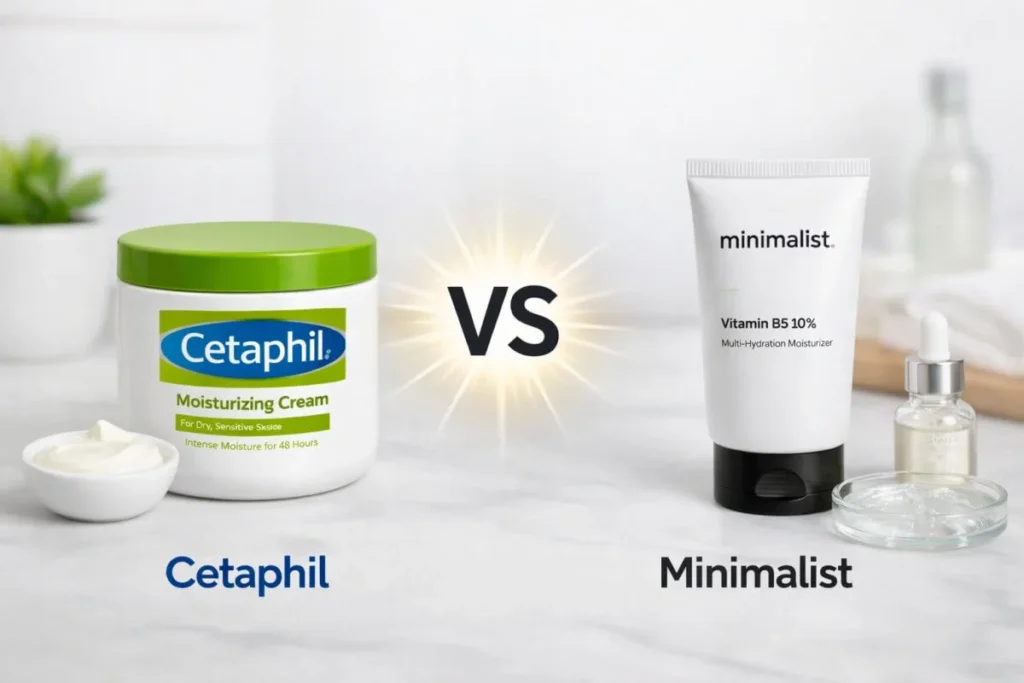
Table of Contents
Fact 1: Why does user feedback lean towards Minimalist?
User feedback is the most practical indicator of any skincare product, as it is based on real-life usage. When reading reviews about Cetaphil, words like “safe”, “gentle”, “no reaction”, “doctor recommended” appear frequently. This means that after using Cetaphil, the skin does not suffer, there is no irritation and the skin remains calm. But at the same time, many users also say that they do not see much “visible change” after using Cetaphil.
On the other hand, feedback about Minimalist is a little different. Users give experiential comments like “feel hydrated”, “feel like the skin barrier has improved”, “texture feels better”. That is, they feel a change in the skin after using Minimalist. The main reason for this is that Minimalist’s formulation is result-oriented.
Cetaphil keeps actives low because its aim is to avoid reactions. Minimalist, on the other hand, actively works on hydration, repair and balance. That is why Cetaphil can be called a comfort moisturizer, while Minimalist is a performance moisturizer. Neither is wrong, it’s just that user expectations are different.
Fact 2: Is a low ingredient count really beneficial?
There’s a common belief in skincare that “less ingredients = better,” but in reality, the issue is not the number of ingredients but their purpose. Minimalist moisturizers have a relatively short ingredient list, but each ingredient is used for a specific purpose—hydration, soothing, or barrier repair. This makes ingredient transparency more evident.
Cetaphil has a slightly higher ingredient list, but most of it is stabilizers, emollients, and skin-conditioning agents. These ingredients are used to keep the product stable, keep the texture consistent, and give the skin a soft feel. So while Cetaphil’s formulation may seem large, it’s not complex.
A short and focused formula can be beneficial for sensitive skin, as it has fewer unnecessary ingredients. But for ultra-sensitive or reactive skin, a very active-focused formula can sometimes be risky. In such a situation, a simple, boring-looking moisturizer like Cetaphil is safer. So, formulation logic is more important than ingredient count.
Fact 3: How does Brand Philosophy change Skin Experience?
Cetaphil and Minimalist have completely different approaches to skincare, and this difference is visible in the skin experience. Cetaphil’s core philosophy is—“Don’t disturb the skin.” That is, to interfere with the skin as little as possible, to give it a calm environment to heal itself. Therefore, strong actives, acids or complex blends are avoided in Cetaphil.
Minimalist’s philosophy, however, is “Fix the skin with science.” That is, to identify what is really lacking or damaged in the skin and use targeted ingredients. That is why Minimalist features panthenol, soothing complexes and hydration boosters.
The practical result of this is that after using Cetaphil, the skin feels calm, but it doesn’t feel like much has changed. After using Minimalist, the skin adapts—hydration improves, the barrier feels stronger. That is why users who use acids, retinol or exfoliation are more attracted to Minimalist.
Fact 4: Both provide hydration, but why does the skin feel different?
Both Cetaphil and Minimalist moisturizers provide hydration, but the way they deliver hydration is different. Cetaphil contains petrolatum and rich emollients, which create a protective layer on the skin. This layer prevents moisture from escaping. This makes the skin feel soft and protected, especially for dry skin.
Minimalist contains humectants like panthenol and hyaluronic acid, which draw water into the skin. This makes the hydration come from within and the texture feels lighter. There is less of a sticky or greasy feel.
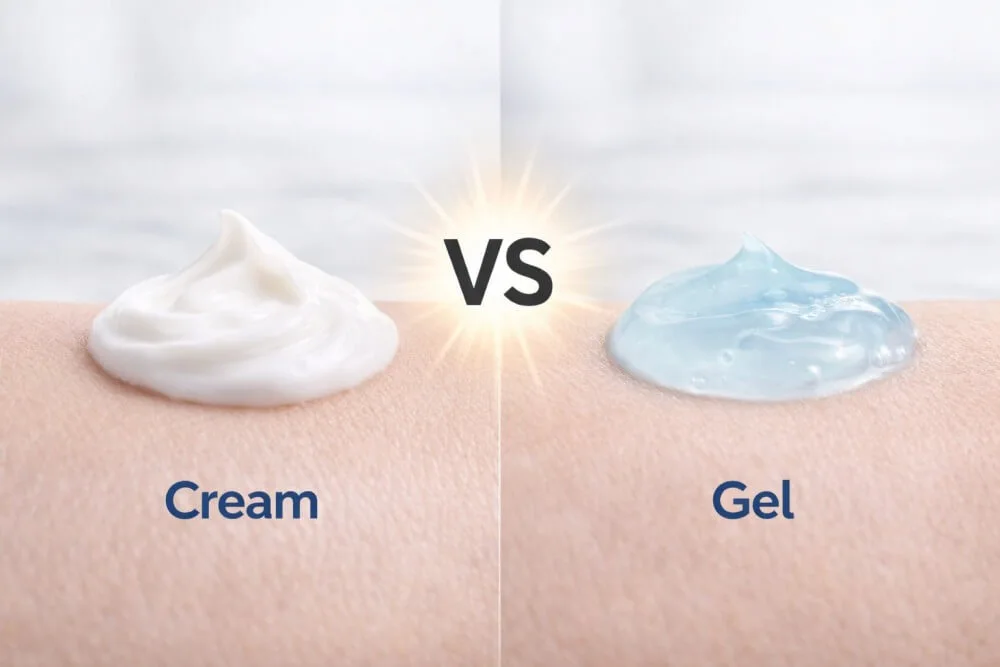
That’s why Cetaphil feels “sealed” after using it, while Minimalist feels “hydrated.” The sealing approach is useful for dry or compromised skin, while lightweight hydration is more comfortable for users living in oily or humid climates.
Fact 5: Why is Minimalist ahead in Barrier Repair?
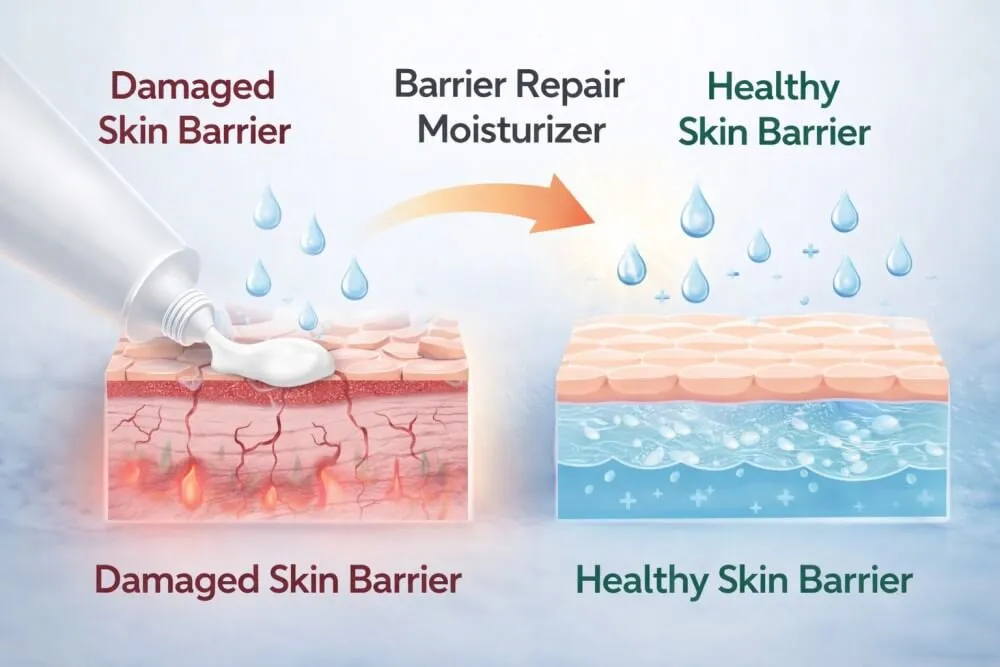
Skin barrier damage can be caused by many factors—over-exfoliation, retinoids, harsh cleansers, or pollution, as dermatology experts also explain in their skin care guidelines. In such cases, the skin needs not only moisture, but also repair support. Minimalist contains Vitamin B5 (Panthenol) and calming complexes, which actively help with barrier repair.
Panthenol supports the healing process in the skin and reduces water loss. Soothing ingredients like Sepicalm reduce irritation. This gradually stabilizes damaged skin.
Cetaphil protects the barrier, meaning it prevents further damage. But it does not claim to actively rebuild the barrier. So if the skin is already damaged, Minimalist is more useful. But if you want to keep the skin stable, Cetaphil’s role is important.
Fact 6: Is it wrong to think Cetaphil is “too basic”?
Cetaphil feels basic because it is intentionally basic. It doesn’t claim to treat acne, control oil, or provide anti-aging results. That’s why some users find Cetaphil boring.
But Cetaphil’s purpose is different—to calm the skin, prevent reactions, and keep the routine stable. When skin is irritated, over-treated, or sensitive, a moisturizer like Cetaphil is very helpful.
So Cetaphil is not a “problem-solving” moisturizer, but a “problem-preventing” moisturizer. That’s its strength, not its weakness.
Fact 7: Why might Minimalist be risky for sensitive skin?
Minimalist has actives, so very sensitive or damaged skin may initially experience a reaction. While panthenol is soothing, the formulation may contain multiple active elements, which can initially sting a compromised barrier.
You may experience mild stinging, tightness, or dryness during the first few uses. Therefore, patch testing is very important for sensitive skin users.
Cetaphil has such a low risk, so it is considered a “no fear” option. Minimalist is effective, but requires a little caution.
Fact 8: Why is texture so important in the Indian Climate?
Heat, humidity, sweat and pollution are all factors in India. In such a climate, heavy creams can feel uncomfortable for oily or combination skin. Cetaphil’s creamy texture can give a greasy feel in summer.
Minimalist’s gel-cream or lotion texture is light and sweat-friendly. Therefore, Minimalist is more comfortable in Indian summers, while Cetaphil seems better for dry skin in winters.
Fact 9: Price vs Value – What is true?
Minimalist generally offers active-rich formulations at a low price, so users feel “value for money”. Cetaphil is a little more expensive, but it has long-term safety, brand trust and dermatologist backing behind it.
Budget-conscious users tend to lean towards Minimalist, while users with skin issues trust Cetaphil.
Fact 10: Why do dermatologists recommend a combination?
Dermatologists take a practical approach. Their logic is to keep the base routine safe and the treatment targeted. So a gentle moisturizer like Cetaphil is used as a base, and a product like Minimalist is used for repair or boost.
This means that the two brands can co-exist, rather than competing.
Conclusion: So, Which Moisturizer Is Best Cetaphil or Minimalist?
There’s no one universal answer to the question “Which moisturizer is best Cetaphil or Minimalist?” — because the right choice depends on your skin type, concerns, and climate.
If your skin:
- is very sensitive
- is prone to frequent breakouts
- is eczema-prone or easily irritated
then a gentle, no-nonsense moisturizer like Cetaphil is a safer option. It calms your skin, doesn’t aggravate irritation, and keeps your routine stable.
But if your skin:
- is barrier-damaged
- uses retinol / acids
- is looking for lightweight hydration
- lives in an oily or humid climate
then Minimalist may seem more targeted and performance-oriented.
🔎 Final Takeaway
- Cetaphil = Calm, Protect, Stabilize
- Minimalist = Repair, Hydrate, Improve
The best moisturizer is the one that suits your skin and that you can use regularly, consistently. In skincare, routine consistency and ingredient compatibility are more important than brand.
Do a patch test before starting a new product and consult a dermatologist if you have persistent skin issues.
FAQs – Natural vs Regular Skincare Brands
1. Is natural skincare always safer than synthetic skincare?
Natural skincare products often use plant-based ingredients, which can make them seem gentle. But “natural” doesn’t necessarily mean 100% safe. Some natural extracts can also cause irritation. So the ingredient list and skin compatibility are more important.
2. Can plant-based moisturizers clog pores?
Yes, some natural oils like coconut oil or certain heavy botanical oils can clog pores in some skin types. If you have oily or acne-prone skin, opting for lightweight and non-comedogenic formulations is a good idea.
3. How can I select a skincare brand that suits my skin?
First, identify your skin type and main concern — dryness, oiliness, acne, pigmentation or sensitivity. Choose products with targeted ingredients accordingly. Formulation logic is more important than brand reputation.
4. Are herbal or natural products effective for long-term results?
Some herbal formulations are good for soothing and maintenance, but for specific concerns (like deep pigmentation or anti-aging), active-based products may be more effective. Long-term results depend on the formulation, not the label.
5. Can I use natural skincare daily without side effects?
In most cases, yes, but for daily use, the product needs to be suitable for your skin type. It is safe to do a patch test when starting a new product and not introduce too many products at once.
6. What matters more – brand name or ingredient quality?
Ingredient quality and formulation balance are more important than brand name. Even if it is a well-known brand, it does not necessarily suit your skin. Therefore, it is important to read the label and observe the skin response.
7. Are natural moisturizers good for sensitive skin?
Some natural moisturizers can be soothing for sensitive skin, but if they contain essential oils or fragrance, they can cause a reaction. It is safer to choose fragrance-free and minimal ingredient products.
Read More

Hi, I’m Abhijeet Bendale — founder of OfferDukan.com.
I am sharing informative lifestyle guides, smart buying tips, and honest product research across Beauty, Tech, Health, Travel, and more. My aim is to help readers find genuine offers, smart shopping tips, and useful product insights that make daily life easier and more affordable.
Thank you for supporting OfferDukan.com!