
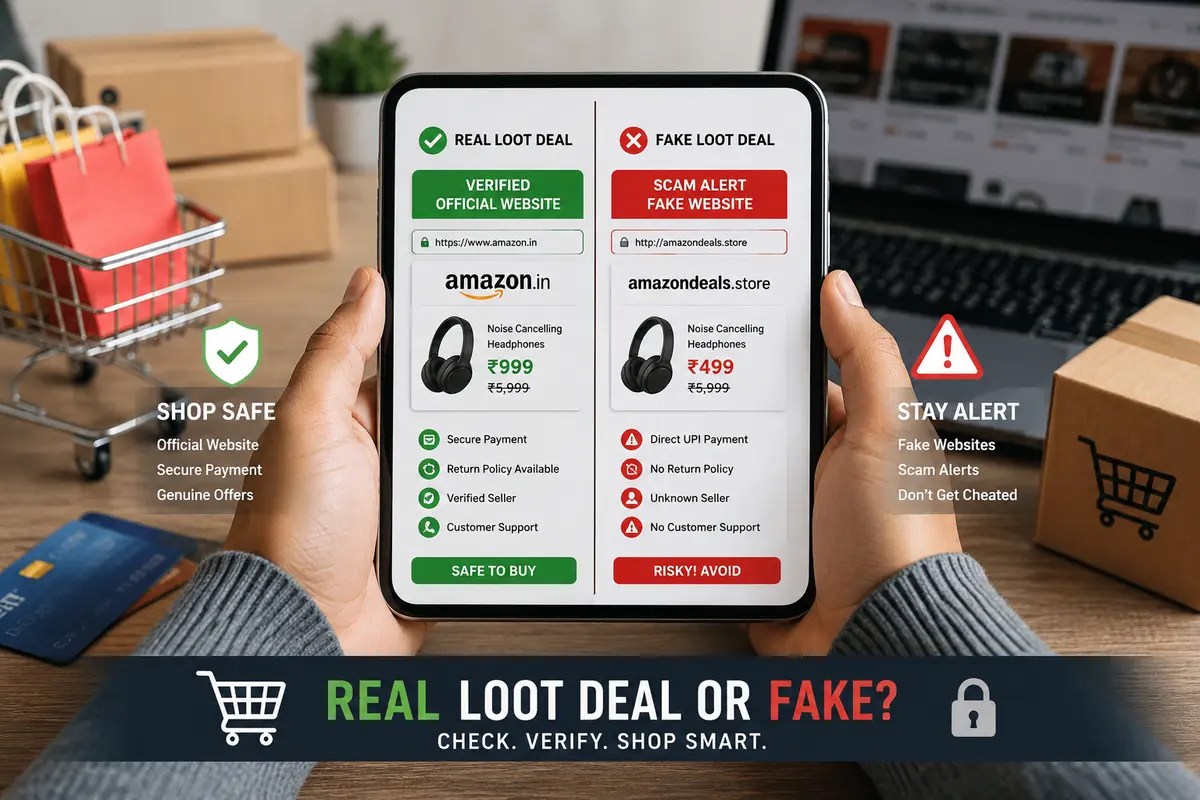
Are Loot Deals Real or Fake? : “Oh look… ₹59,999 iPhone available for just ₹4,999!”
While scrolling through his mobile late at night, Rahul received this message on WhatsApp. He opened the link, and the website looked exactly like Amazon. He paid in a hurry. The order was confirmed, but after that, neither the parcel arrived nor did the website open. A few days later, he realised that he had become a victim of a Fake Loot Deal.
On the other hand, in the same week, his friend saved about ₹18,000 using bank offers, coupons and exchange offers during Flipkart Big Billion Days. This was also a Loot Deal, but it was completely real.
Then the question arises…
Key Takeaways
- Not every Loot Deal is fake.
- Always buy from trusted websites.
- Verify the seller before purchasing.
- Check customer reviews carefully.
- Avoid direct UPI payments to unknown sellers.
- Compare prices before buying.
- Read the return and refund policy.
- Use secure payment methods only.
- Think before you click “Buy Now.”
Are Loot Deals Real or Fake?
This cannot be answered in one word.
Because not all Loot Deals are scams and not all Loot Deals are real.
Today, many people buy based on the offers they see on Telegram, WhatsApp, Instagram, and Deal Apps. Some save thousands of rupees, while others get cheated.
That is why in this article we are going to learn:
- What is a Loot Deal?
- Are Loot Deals real or fake?
- Which deal should you trust?
- Which website should you stay away from?
- 9 Smart Tips to Avoid Cheating
If you are a regular online shopper, then definitely read this article till the end.
What is a Loot Deal?
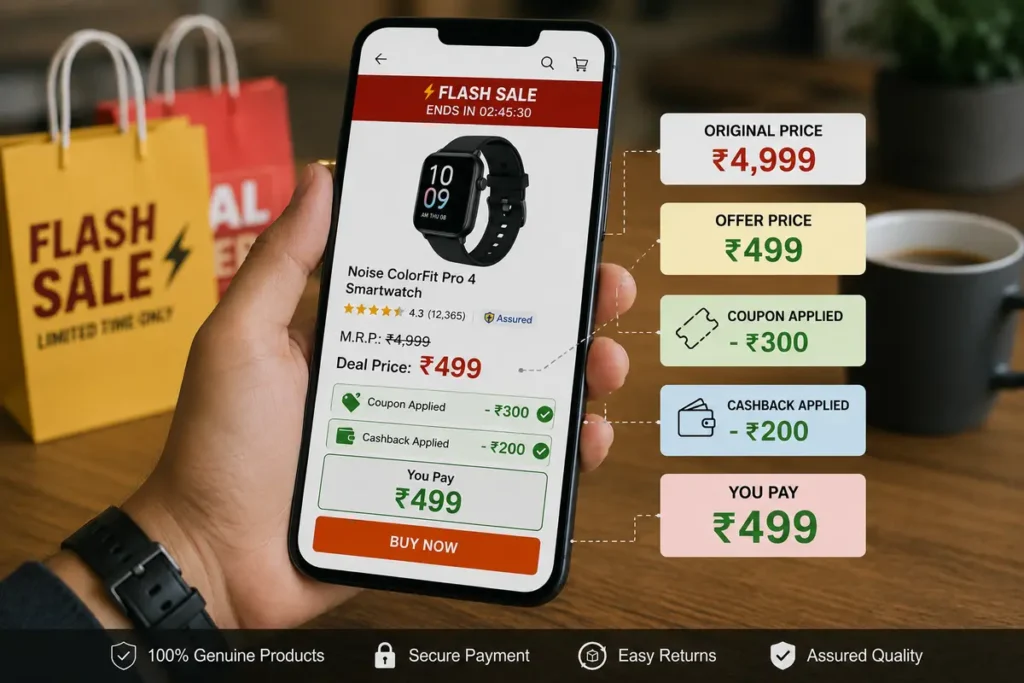
A Loot Deal is a product available at a much lower price than its original price.
For example,
₹2,999 Earbuds for ₹299
₹15,000 Smartwatch for ₹2,999
₹50,000 Laptop for ₹34,999
Such offers come for many reasons.
Let us see what those reasons are now.
Main reasons
The following are some of the main reasons due to which such offers come, such as
- Flash Sale
- Bank Offer
- Coupon Code
- Cashback
- Festival Sale
- Clearance Sale
- Pricing Error
- Limited Time Offer
This does not mean that every big discount is a scam.
Are Loot Deals Real or Fake?
The answer is — Both.
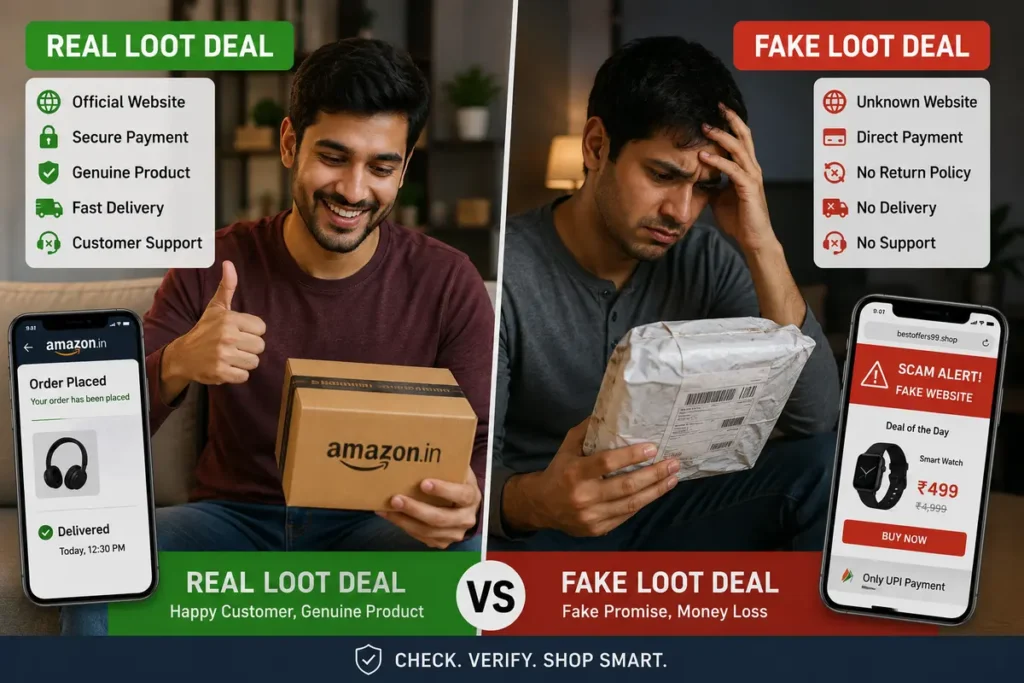
It completely depends on where and how you get the deal. Because if the deal you get is from the official website, it is definitely real, but some deals are available on fake websites, so those deals can be fake.
Real Loot Deals
Real loot deals are those deals that are offered by real and trusted companies, such as the following types of offers that are generally reliable.
- Amazon Lightning Deals is offered through Amazon.
- Flipkart Big Billion Days is offered through Flipkart.
- Myntra EORS Sale is offered through Myntra.
- The deals in Ajio Big Sale are offered through Ajio.
- Bank Instant Discount is offered through banks.
- Credit Card Offers are offered on the eligibility of different credit cards.
- Exchange Bonus
These offers are offered by official companies.
Fake Loot Deals
On the other hand, some Scam Deals are designed to deceive customers.
Example :
- Fake Shopping Website
- Telegram Payment
- WhatsApp Order
- Instagram Store
- Advance Payment Scam
- Often after paying at these places
- Product does not arrive
- Duplicate Product arrives
- Website closes
- Seller disappears
Therefore, every buyer or customer should check whether the website they are dealing with is official or not.
How is a Real Loot Deal created?
Many people think that why would a company sell goods at such a low price?
In reality, there are commercial reasons behind it.
1. Flash Sale
Flash sale is a discount given for a limited time. A specific time is given for this deal and this deal can be obtained during that time. It is activated during that time.
Purpose
- Increase Website Traffic
- Customer Attraction
- Stock Movement
2. Pricing Error
Pricing Error means that sometimes the wrong price is updated. In such a case, the deal is closed within a short time.
Example
₹1,999 instead of ₹19,999
Such deals end in a few minutes. Therefore, deals can also be obtained through Pricing Error, but they end in a few minutes.
3. Clearance Sale
The company is preparing some policies to sell its old goods, in such a case, clearance sale deals are given so that it can be sold to me. These deals are given only to sell old goods.
4. Coupon Combination
Sometimes companies sell products by giving different discounts as well as cashback and different bank offers. In such cases, the price of that product gets reduced a lot and seeing this, the customers immediately buy that item, so you can also get loot deals through coupon combination.
Coupon + Cashback + Bank Offer, due to which the final price is reduced a lot.
Many genuine Loot Deals become even more attractive when combined with cashback offers from payment apps like Google Pay. However, many users are unsure how to use or redeem their earned rewards effectively. Understanding how Google Pay rewards work can help you maximise your savings while shopping online.
Read Also: How to Convert Google Pay Rewards to Cash: 100% Working Method
5. Bank Offers
If you use a specific Debit Card or Credit Card, you get an additional discount. Such offers are given only by the bank. Therefore, all the offers given by the bank are genuine.
Why are Loot Deals so popular in India?
Digital Payments and Online Shopping are growing rapidly in India.
Due to this, consumers are increasingly looking for Discounts, Cashbacks and Flash Sales.
This is why Deal Sharing Apps and Deal Communities have also become very popular.
How to Identify a Fake Loot Deal?
Nowadays, fraudsters create websites that look exactly like Amazon, Flipkart or other popular websites. So, don’t trust the looks of the website alone.
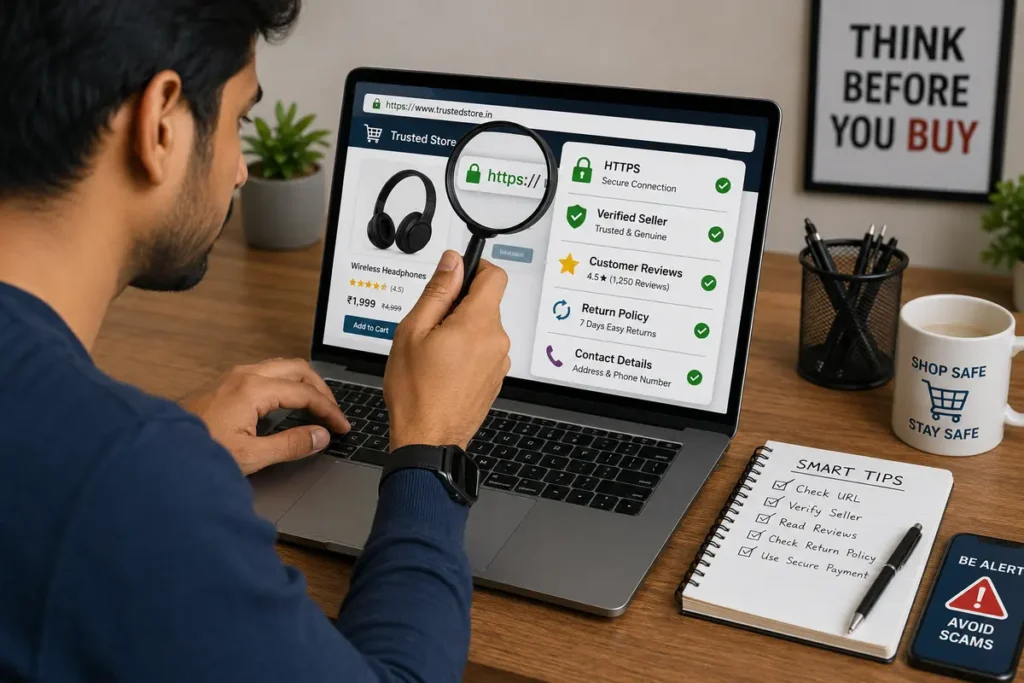
You can avoid most Online Shopping Scams by using the following 9 Smart Tips.
Tip 1. Check the Website URL carefully
This is the most important thing.
For example,
✅ amazon.in
❌ amazon-offers-sale.xyz
❌ amaz0n-deals.shop
Scammers often use the same name as the original website. Only one or two letters are changed.
Pro Tip: Always check if the URL has HTTPS (🔒 Lock Icon). However, having HTTPS does not necessarily mean that the website is 100% secure.
Tip 2. Beware of Unrealistic Discounts
If you see a laptop worth ₹80,000 for just ₹999 or an iPhone worth ₹1,20,000 for ₹4,999, consider whether the offer is really worth it.
It may be a big discount, but an unbelievable price can be a big sign of fraud.
Ask yourself this question:
“Why would a company sell this product at such a low price?”
Tip 3. Check Seller Ratings and Reviews
If you are buying on Amazon, Flipkart or Myntra, always check the Seller Ratings.
Also:
- Read Verified Reviews.
- Don’t trust only 5-Star Reviews.
- Read 1-Star and 2-Star Reviews too.
This gives real information about both the product and the seller.
Tip 4. Read Return and Refund Policy
Fake websites often:
- No returns.
- No refunds.
- No contact support.
- A trusted website has a clearly written return policy.
If you can’t find the Return Policy, think twice before buying. Because if the return policy is not there on that website, then that website is not real or fake.
Tip 5. Don’t rush to make an advance payment
Telegram or WhatsApp often says:
“Pay now, otherwise the offer will end.”
Don’t give in to such pressure.
If possible: Use Cash on Delivery (COD), Credit Card, Trusted Payment Gateway. Don’t pay immediately when asked.
Before making any online payment, always follow the Learn UPI Safety Tips from NPCI guidelines to protect yourself from payment fraud and online scams.
Tip 6. Check Social Media Page
Even if the website is new, it should have a Social Media Presence.
Check:
- Facebook Page
- Instagram Account
- Customer Comments
- Review Section
If the page was created yesterday and there is no real response, be careful. In short, it is necessary to check the trustworthiness.
Tip 7. Check Contact Information
A reliable website has the following information.
- Contact Number
- Email Address
- Office Address
- GST Details (if applicable)
If there is no “Contact Us” page, then that is a big Red Flag. Because on any official website, there is always a Contact us page so that people who visit that website can contact that company or that person.
Tip 8. Check Price History
Sometimes the seller first artificially increases the price and then shows an 80% discount.
Example:
- Yesterday’s price: ₹2,999
- Today’s price: ₹5,999
- Offer Price: ₹2,999
In such a case, you do not actually save any money.
It is a good habit to check the price using Price History Tools. This will immediately let you know what the previous price was for each product or service, so you will not fall prey to such frauds.
Tip 9. Do not click on Unknown Links
Be especially careful with links coming from the following places.
- WhatsApp Forward
- Telegram Message
- SMS Link
- Email Offer
- Facebook Comment
Always open the website yourself by typing it in the browser.
Because clicking on an unknown link can redirect you to another site and your information can be stolen, so that information can also be used for wrong purposes.
Real Loot Deal vs Fake Loot Deal: Key Differences at a Glance
The following are some key differences between Real Loot Deals (Offers) and Fake Loot Deals (Offers)
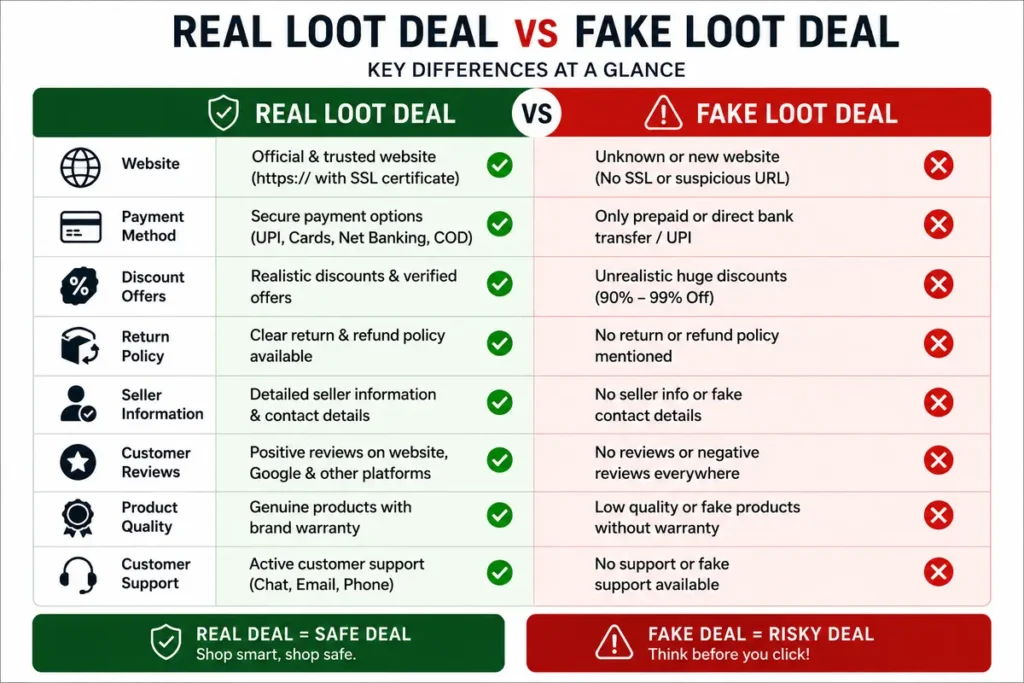
| Real Loot Deal | Fake Loot Deal |
|---|---|
| Official Website | Unknown or Suspicious Website |
| Secure Payment Gateway | Direct UPI or Personal Payment Request |
| Return & Refund Policy Available | No Return or Refund Policy |
| Customer Support Available | No Customer Support |
| Verified Seller | Seller Information Missing |
| GST Details Available | GST Details Not Available |
| Genuine Bank Offers | Only Advance Payment Requested |
| Verified Customer Reviews | Fake or Manipulated Reviews |
| Order Tracking Available | No Order Tracking |
| Proper Invoice Provided | No Invoice or Bill |
| Secure HTTPS Website | Insecure or Suspicious Website |
| Transparent Contact Information | Fake or Missing Contact Details |
| Brand Warranty Available | No Warranty |
| Trusted Payment Methods | Unverified Payment Methods |
| Products Delivered as Described | Wrong, Duplicate, or No Product Delivered |
5 Things to Remember When Shopping Online
- Don’t make hasty decisions.
- Verify every offer.
- Read reviews.
- Check if the website is trustworthy.
- Think for two minutes before making a payment.
Growth of Online Shopping and Loot Deals in India
Online shopping in India has seen a huge growth in the last few years. With smartphones, cheap internet and UPI payments, millions of customers shop on Amazon, Flipkart, Myntra, Ajio and other e-commerce websites every day.
Along with this, the popularity of Deal Sharing Apps, Coupon Websites and Telegram Deal Channels has also increased. Many customers get genuine discounts through these channels, while some fall prey to fake offers.
Due to this, when shopping online, “Trusting the Website is more important than the Discount.”
Key Statistics About Online Shopping in India
Note: The following statistics are based on reports from IBEF, NPCI and other industry sources.
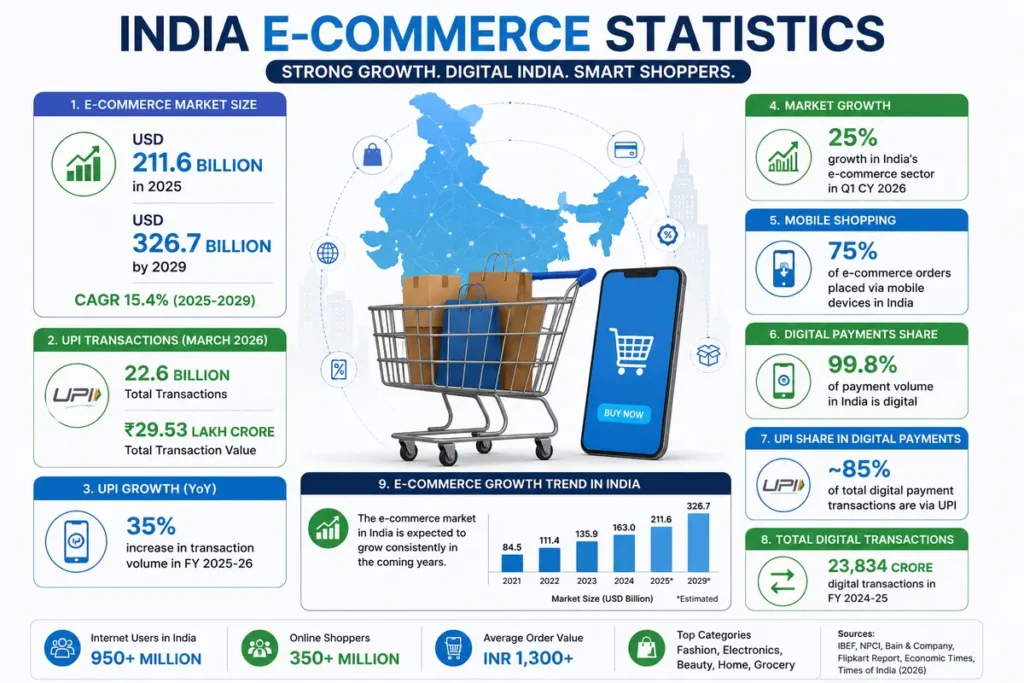
1. India’s e-commerce market is growing rapidly
India’s e-commerce market is estimated to be worth around US$211.6 billion in 2025 and is expected to reach US$326.7 billion by 2029. The major factors behind this are increasing internet usage, smartphone penetration and digital payments.
2. UPI transactions have reached record highs
In March 2026, 22.6 billion (22.6 Billion) transactions were processed in India through UPI, with a total value of ₹29.53 lakh crore. This shows the growing trust of consumers in online shopping and digital payments.
3. India’s e-commerce sector recorded 25% growth
According to a joint report by Flipkart and Bain & Company, the Indian e-commerce sector recorded a 25% growth in the first quarter of 2026. Increased consumer confidence and the growing trend of digital shopping are the main reasons behind this.
4. Festive season drives massive online shopping
According to analysts’ estimates, e-commerce orders were expected to increase by 15% to 20% during the festive season of 2025. Big Billion Days, Great Indian Festival and other festive sales were the key factors behind this growth.
5. Mobile shopping dominates e-commerce
About 75% of e-commerce transactions in India are done on mobile devices. Therefore, consumers mainly use smartphones to view Flash Sales and Loot Deals.
Due to this growing trend of online shopping, the number of Fake Loot Deals and Online Shopping Scams is also increasing. Therefore, it is very important to verify every offer before trusting it.
Expert Tips
If an offer seems too tempting, ask yourself these three questions:
- Who is offering this offer?: Is it an official website or an unknown seller?
- What is the reason for such a big discount?: Is it a Flash Sale?, Is it a Bank Offer?, or is it just a false advertisement to attract customers?
- Will I have proof after payment?: Are Invoice, Order ID, Customer, Support, Refund Policy all available?
Check the available Discount and Cashback before paying through Credit Card. For that, this article How to Check My HDFC Credit Card Offers? 5 Proven Steps will be helpful.
Common mistakes that customers make
Many people make the following mistakes.
- Ordering just by looking at the discount
- Not reading reviews
- Trusting unknown websites
- Paying through WhatsApp links
- Not reading the return policy
- Not checking seller ratings
This is why online shopping scams often occur.
How can we help customers?
The right information is the biggest protection.
Our aim is not just to show cheap deals, but to make every customer aware of safe online shopping.
We provide the following types of information.
- How to verify deals?
- How to identify a fake website?
- Is a coupon safe?
- Online Shopping Tips
- Banking and Digital Payment Awareness
This allows customers to shop online with more confidence and security.
Frequently Asked Questions (FAQs)
1. Are Loot Deals Real or Fake?
Both. Loot Deals on official e-commerce websites are generally trustworthy, while offers on unknown websites can be fraudulent.
2. Are Loot Deals safe?
If the deal is available through an official website, a trusted seller, and a secure payment gateway, it is relatively safe.
3. Should you trust Loot Deals on Telegram?
Not every Telegram deal is fake. But it is necessary to verify the website, seller, and payment method before making any purchase.
4. How to identify a fake shopping website?
Check HTTPS
Check the domain name
Check the contact details
Read the return policy
Check reviews
Check social media presence
5. Where is the safest place to shop online?
Always buy from official e-commerce websites or official brand stores.
6. Does a big discount always mean a fake deal?
No. You can get really big discounts in Festival Sale, Bank Offer, Cashback, Clearance Sale, and Flash Sale.
7. What to do if you are scammed?
Contact the relevant website.
Inform your bank.
Save evidence of the transaction.
If necessary, file a complaint on the National Cyber Crime Complaint Portal.
Conclusion
Are Loot Deals Real or Fake? This question cannot be answered simply with a “yes” or “no”. Because some Loot Deals are completely real and if taken advantage of at the right time, you can save thousands of rupees. However, some fake websites and social media posts take advantage of the greed of customers and cheat them.
Therefore, do not make an enthusiastic decision on seeing any Deal. Make sure that the website is trustworthy, seller information, customer reviews, return policy and payment method before buying.
Remember, a Smart Shopper does not just see a big discount, but also checks the truth behind that Deal. The next time you see a Loot Deal, will you order it directly or verify it first?
- Disclaimer: The information in this article is provided for educational and awareness purposes only. We do not endorse or guarantee any specific website, seller, app, offer or Loot Deal. Please verify the credibility of the respective website, seller information, price, terms and conditions, return policy and payment method yourself before making any online purchase. Readers are solely responsible for any financial or purchasing decisions.
References :
- India Brand Equity Foundation (IBEF)
- NPCI (National Payments Corporation of India)
- Bain & Company
- Flipkart Reports
- Economic Times
- Times of India

Founder of OfferDukan.com | Digital Rewards & Smart Savings Researcher
Abhijeet Bendale is the founder and chief content strategist behind OfferDukan.com, a premier micro-niche platform dedicated to helping users maximise their digital wallets, unlock hidden cashbacks, and master the art of smart online savings.
With a passion for decoding complex reward systems, analysing fintech trends, and tracking online loot deals, Abhijeet focuses on delivering simple, honest, and highly actionable guides. His mission is to turn everyday digital transactions into opportunities for continuous savings and online earning.