Is a Freebie Really Free? A young man named “Anurag” was scrolling online. Suddenly, he saw an advertisement – ”Skincare kit worth ₹2,999 absolutely free! Today only!”
The offer seemed attractive, and he immediately clicked. After filling in his name, address and mobile number on the website, he finally had to pay a ₹299 shipping charge. After a few days, he started receiving constant promotional calls and emails.
On the other hand, his friend ordered a Free Perfume Sample from the official website of a famous brand. She did not pay any money, and within a few days, she actually received the free sample.
Then the question arises—is a Freebie really free?
The answer to this is not a simple “yes” or “no”, but depends on the terms of the offer, the credibility of the company and the care taken by the customer.
In this article, we will learn in detail the truth behind freebies, why companies offer Freebies, which offers are really free and how to avoid scams.
Key Takeaways: Is a Freebie Really Free
- A “freebie” is not necessarily 100% free; some offers may involve shipping charges, subscription fees, or other conditions.
- Read the terms and conditions carefully before accepting any freebie.
- Obtain freebies only from official and trustworthy websites.
- Never share OTPs, CVVs, UPI PINs, passwords, or confidential banking information.
- Ensure that auto-renewal is not enabled for free trials.
- Freebies are part of a company’s marketing strategy to acquire new customers and boost brand awareness.
- Check for HTTPS, customer reviews, and official company information to identify genuine freebies.
- Only an informed consumer can avoid online fraud and hidden costs.
Is a Freebie Really Free?
We see ads like “Free”, “100% Free”, “Get Free Sample”, “Free Gift” every day in online shopping, mobile apps, banking offers and social media. But one question comes to mind for many – is a Freebie really free?
The answer to this is both yes and no.
Some Freebies are completely free, while some have certain conditions. Therefore, it is important to understand the conditions before accepting any Freebie.
In this article, we will learn in detail what a Freebie is, why companies offer Freebies, which Freebies are really free and which offers may have hidden conditions.
What is a Freebie?
A Freebie is a product, service, or digital item that is given to a customer for free.
This can include the following:
- Free Product Samples
- Free Trial Subscription
- Free eBooks
- Free Software
- Free Coupons
- Free Gift Cards
- Free OTT Trial
- Free Online Courses
- Free Beauty Products
- Free Food Samples
The company does not charge the customer directly for the item.
Is a Freebie Really Free? Truth Is–
The answer to this varies depending on the situation.
Yes, if…
- There is no charge.
- No credit card information is requested.
- Subscription is not automatically started.
- No hidden charges.
- Shipping is also free.
- Such a Freebie can be considered truly free.
No, if…
- Shipping charges are charged.
- Money is automatically deducted after the Free Trial ends.
- Membership is mandatory.
- Minimum purchase is required.
- The freebie is not available without completing a referral.
- In such an offer, the Freebie is not completely free.
The Federal Trade Commission (FTC) Consumer Guide can be helpful for information on free offers, free trials, and consumer protection.
Why do companies give freebies?
Many people think that companies give away products at a loss. In reality, this is not the case.
1. To get new customers
After using a free product, the customer is more likely to buy it later. Because the product has been used by those customers, they can encourage others to buy that product, so some companies give freebies to get new customers.
2. Testing a new product
Free samples are given to test the response of customers before launching a new product in the market. Because customers use those samples and if there are any flaws or good things in them, they also give feedback to those companies, so some companies give products as freebies to test such new products.
3. To increase brand awareness
After receiving a free product, customers share it on social media or tell their friends. In this way, the product and the brand of that product reach people; that is why companies give freebies to customers to increase brand awareness in this way.
4. To collect customer data
Some companies give freebies to get an email, a mobile number or an address. After getting this data, companies call the customers directly to promote some of their products or to provide information about different services, facilities, schemes or do marketing through SMS, so freebies are given to get this data.
5. Marketing Campaign
Freebies are an effective promotional tool in Digital Marketing. Because customer data is obtained through freebies, new customers are also obtained, and brand awareness is also created, it is known as a good marketing campaign.
Types of Freebies
There are some types of freebies, through which companies deliver different products to the customers, such as
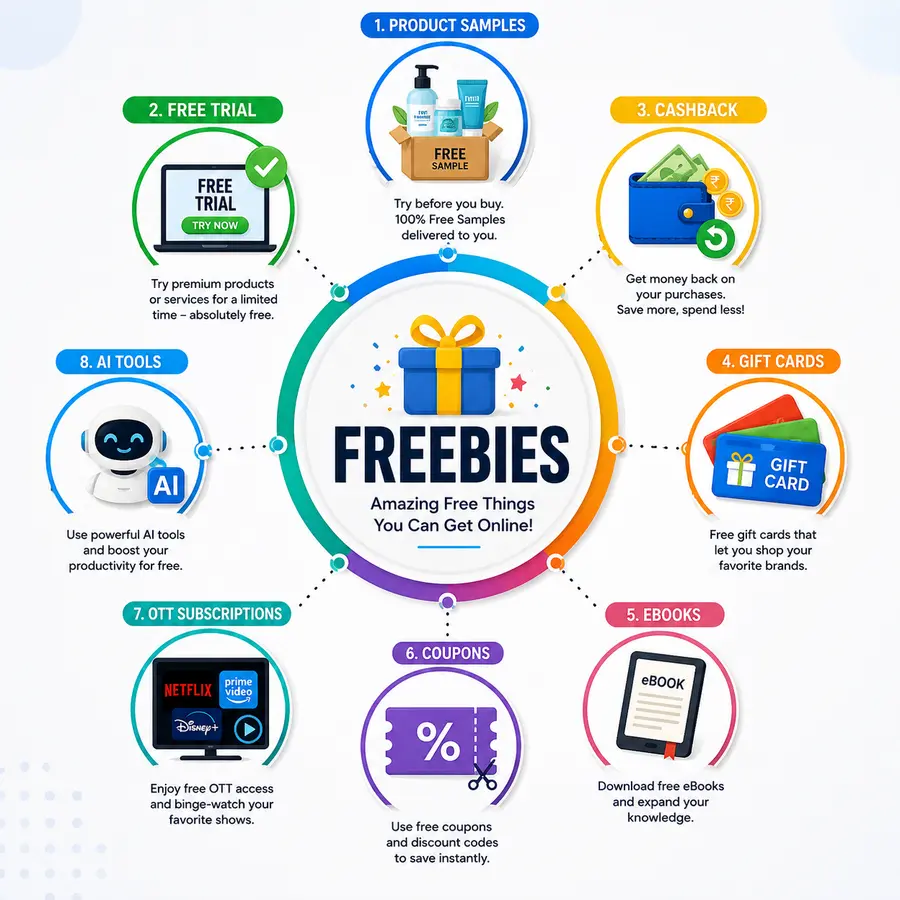
1. Product Samples
The following types of items are given as freebies in product samples.
- Shampoo
- Perfume
- Coffee
- Chocolate
- Skincare Products
2. Digital Freebies
The following digital items are given as freebies through digital freebies.
- PDF
eBook
Templates - Software
- Mobile Apps
3. Free Trial
Subscriptions to some of the following platforms are given as freebies through a free trial.
- OTT Platforms
- AI Tools
- Cloud Storage
- Premium Apps
4. Cashback Freebies
On some transactions, cashback freebies are also given to the customer; for that, you also have to use a specific UPI.
- UPI Offers
- Wallet Cashback
- Bank Rewards
5. Buy One Get One
This is a common type of freebie. Buy One Get One means that if you buy one item, you get another item for free, of the same item.
Check these things before taking every Freebie
1. Terms & Conditions
If the company from which you are given freebies has some small print terms or rules related to those freebies, read them carefully. Read the terms and conditions written in small print. Be sure to read the terms and conditions written in small print.
2. Shipping Charges
Some websites offer products for free but charge for delivery. That is, they attract customers by saying that the product is free and they charge the shipping charges, which are the costs involved in delivering the product to you, to the customers.
3. Auto Renewal
Check whether the subscription will start after the Free Trial. Because there are some subscriptions that are initially taken from you for free, and then their auto-renewal is started.
4. Privacy Policy
Read what your personal information will be used for. You will get all the information about this on the privacy policy page of that company or that product.
5. Is the Website Authentic?
Always take freebies from the official website. There are many websites on the internet that either show you freebies, steal your money or collect your information. So, always stay away from such fake websites. Make sure to check whether the website from which you are going to get freebies is authentic or not.
How to Identify a Genuine Freebie?
If you see the following signs, the freebie is more likely to be reliable.
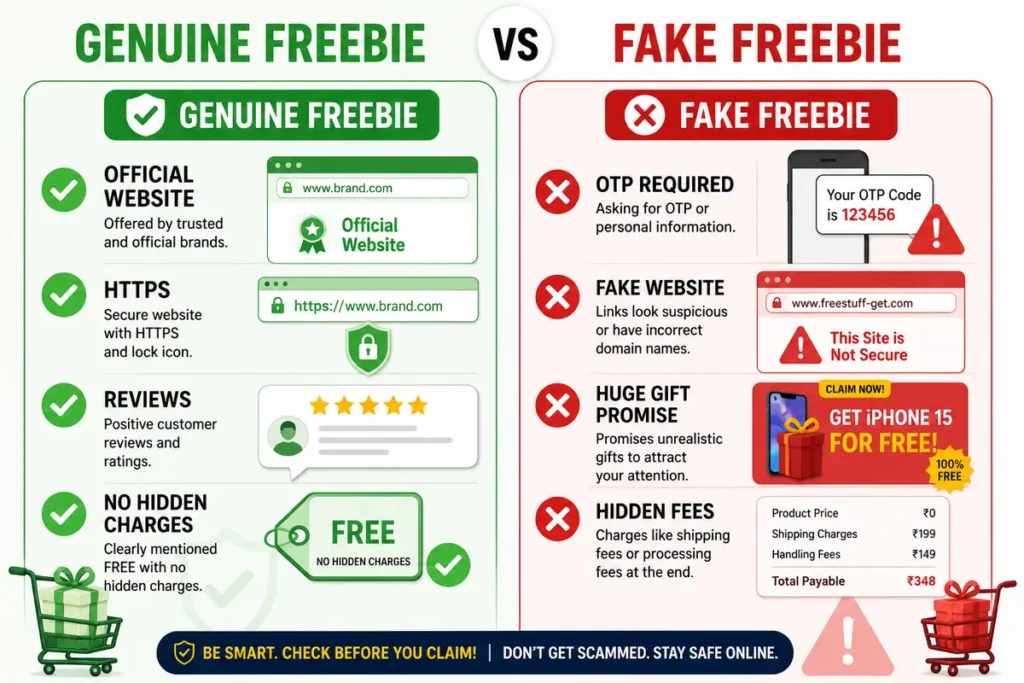
- Official company website
- Clear Terms & Conditions
- Secure HTTPS website
- No hidden fees
- Good Customer Reviews
- Contact information available
If you notice the above things, you can easily identify whether the freebie is genuine or not.
For more information on how to avoid online fraud, you can check out the guidelines on the Google Safety Centre.
How to Identify Fake Freebies?
Be careful if you see the following things.
- Pay first
- Requesting OTP
- Requesting bank account information
- Link on WhatsApp only
- Unreasonably expensive gifts
- Very short-term pressure
If you find the above things in your freebie transactions, understand that these are fake freebies.
Benefits of Freebies
- Now let’s see what benefits you can get from freebies.
- The customer gets to try new products.
- Most importantly, the customer saves money.
- The company gets information about its new brand.
- The customer gets to experience Premium Services.
- Useful for students and beginners.
Disadvantages of Freebies
Just as everything has a good side, it also has a bad side. So now we will see what the disadvantages of freebies are.
- Spam Emails may increase.
- Personal Data may have to be shared.
- Auto Subscription may apply.
- Shipping Charges may apply.
- Fake Offers may cause fraud.
Avoid these mistakes while accepting freebies.
- Before taking freebies, that is, while accepting freebies, you should avoid some of the following mistakes,s such as,
- Not reading the terms. If you do not read the terms and conditions, you may have to pay extra charges.
- Trusting unknown websites. If you take freebies from an unknown website, your data may be leaked, ed and cyber fraud may occur.
- Giving Bank Details. You do not want to give bank details to anyone, as this can lead to theft of money from your bank.
- Sharing OTP. Do not share the OTP you receive with anyone.
- Using a password. Always use your password carefully.
- Do not turn off Auto Renewal. This will not charge you any fees.
How to get freebies safely?
Avoid the above mistakes, and you will be able to get freebies properly. Following are some important things for this,s like,
- Use only the official website. This will get you official freebies.
- Use a different email ID. So that similar email marketing messages do not come to your regular email.
- Check HTTPS. This will help you understand whether the website is real or not.
- Read the review. This will help you understand whether the freebie sample product is suitable or not.
- Remember the Subscription Date. Because at that time, money could be deducted from your subscription.
- Turn off Auto Renewal. So that you do not lose money for those offers.
Common misconceptions about freebies
1. “Free is always a scam.”
Wrong. Many reputable companies offer real Free Samples. Therefore, it is a big misconception among customers that free is always a scam. So this is not the case.
2. “Free stuff is always inferior.”
Wrong. Many companies offer full-quality samples. Therefore, it is a misconception among consumers that the free stuff is of low quality or inferior.
3. “All Free Trials charge money.”
Wrong. Some services auto-renew, while others automatically close after the trial ends. Therefore, not all free trials charge money. Therefore, consumers should remove this misconception from their minds.
Why is consumer awareness important when accepting freebies?
In the digital age, the word “Free” attracts consumers’ attention. But not every free offer is necessarily beneficial to you.
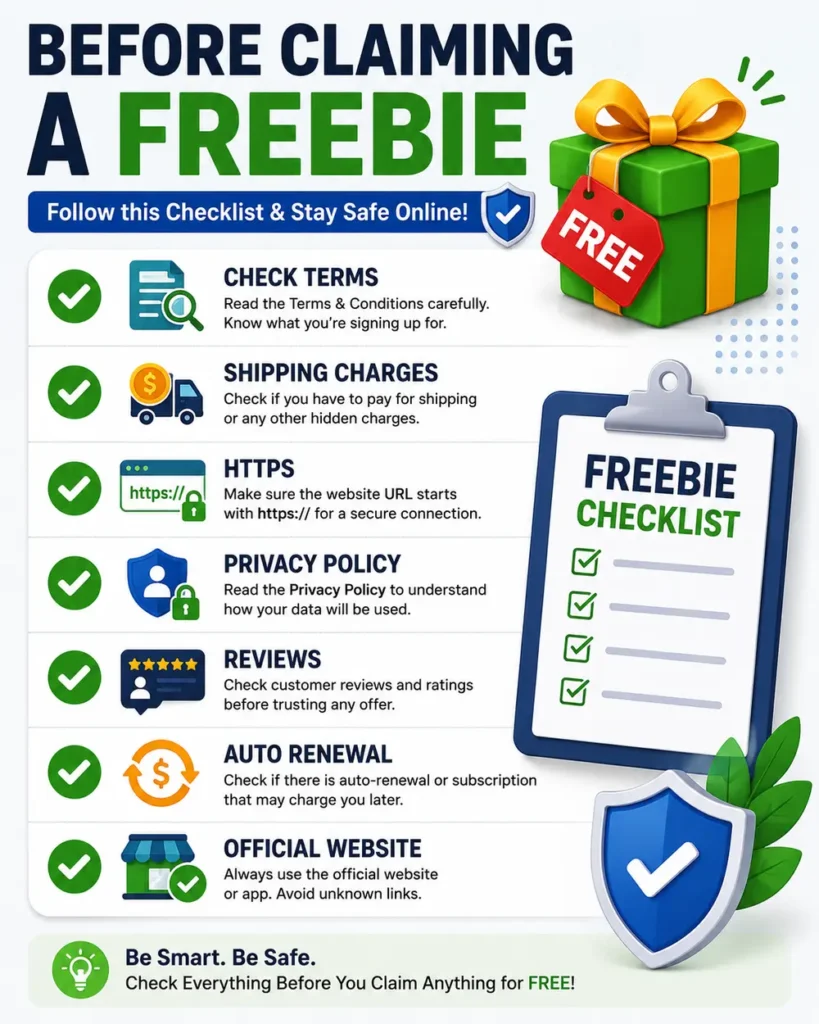
As a consumer, it is important to be aware of the following things. Therefore, all consumers need to be aware of freebies. If consumers are aware, they will not fall for anything.
Ask yourself these 7 questions before accepting an offer.
- ✔ Is this offer from an authorised company?
- ✔ Are the Terms & Conditions clear?
- ✔ Is there a shipping charge?
- ✔ What will my personal information be used for?
- ✔ Will money be deducted after the free trial?
- ✔ Is the website HTTPS secure?
- ✔ Are the reviews and ratings good?
Remember: an informed consumer not only saves money but also protects themselves from online fraud, data theft, and unnecessary subscriptions.
For more information about consumer complaints and consumer rights in India, visit the National Consumer Helpline.
Frequently Asked Questions (FAQs): Is a Freebie Really Free
1. Is a Freebie always 100% free?
No. Some Freebies are completely free, while others may have shipping charges, subscriptions, or other terms and conditions.
2. What is the difference between a Free Trial and a Freebie?
A Freebie is a product or service that is given away for free. A Free Trial is a limited-time opportunity to try out a service.
3. Are Free Samples Safe?
Free Samples from authorised and trusted companies are generally safe.
4. Should I give my bank details when getting a Freebie?
No. Never share your bank account, card number, CVV, or OTP unless it is necessary.
5. Are Freebies Really Worth It?
Yes, if they are from trusted sources and the terms and conditions are clearly understood.
Related Article:
Conclusion
A freebie is not always a scam or a hidden cost. Many companies offer freebies to give customers a product experience, gain new customers, or increase brand awareness.
However, it is essential to check the Terms & Conditions, Shipping Charges, Auto Renewal, Privacy Policy, and the credibility of the website before accepting each offer. Choosing Freebies based on the right information can help you avoid unnecessary expenses and online fraud.
Disclaimer: The information in this article is provided for educational and informational purposes only. The terms, conditions, eligibility, availability and duration of Freebies, Free Samples, Giveaways and Promotional Offers are subject to change from time to time. Please check the Terms & Conditions, Privacy Policy and other details on the official website of the respective company before accepting any offer. Do not provide OTP, CVV, UPI PIN, password or other sensitive financial information to anyone. OfferDukan.com or the author will not be liable for any financial loss, data misuse or other damages resulting from any decision taken based on the information in this article.
References
- Federal Trade Commission (FTC) – Consumer Protection Guidelines
- Google Safety Centre – Online Safety & Security Resources
- National Consumer Helpline (Government of India)
- Consumer Reports – Online Shopping & Scam Awareness
- Better Business Bureau (BBB) – Scam Prevention Resources
- HubSpot – Consumer Marketing Trends Report
- Nielsen – Global Trust in Advertising Study
- Statista – Consumer Behaviour and Digital Marketing Statistics

Founder of OfferDukan.com | Digital Rewards & Smart Savings Researcher
Abhijeet Bendale is the founder and chief content strategist behind OfferDukan.com, a premier micro-niche platform dedicated to helping users maximise their digital wallets, unlock hidden cashbacks, and master the art of smart online savings.
With a passion for decoding complex reward systems, analysing fintech trends, and tracking online loot deals, Abhijeet focuses on delivering simple, honest, and highly actionable guides. His mission is to turn everyday digital transactions into opportunities for continuous savings and online earning.